A small hot ball of rice, mixed with a dab of ghee and a sprinkle of salt, fed to me by the loving fragrant and slightly wrinkled hands of my grandma... I want a morsel of 'that' simply flavoured rice, a morsel of the simplicity of childhood...
Sunday, 21 April 2013


Thursday, 21 March 2013
Hummus
For me, memories get attached to a food experience. So apart from the taste, flavours, touch, smell and textures of the food I am eating, the memories I create become an integral part of the food experience. So when I want to revisit those memories, I try and cook that dish in the kitchen. Since yesterday I have wanted to revisit some beautiful memories I have created eating hummus with fried pita bread from a small shop in the food court of a local mall so here I have been able to cook it today (the chickpeas need overnight soaking!)
Hummus is a traditional Lebanese dip made of chickpeas with a drizzle of olive oil on top served with hot and fresh soft pita breads (though fried pita bread sticks make for an interesting texture combination). Though not bland, it doesn't have too many complicated flavours (and isn't a complicated recipe!) and goes well with chips, khakra, and other such kinds of bread! It is also a spread used in falafel sandwiches and rolls.

Hummus
Ingredients
1 cup chickpeas soaked overnight
5 tbsps seasame seeds
8-10 garlic cloves
3 tbsps Olive oil
Salt to taste
Water to adjust consistency
Method
Soak the chickpeas overnight at least for 10 to 12 hours and cook in a pressure cooker till done.
To make the tahini paste (that can be used in baba ghanouj, another Lebanese dip), toast the sesame seeds lightly in a thick bottomed pan on slow heat till they are slightly brown and before they start popping out of the pan like popcorn. Blend this in a food processor or mixer with 1 tbsp of the olive oil or a bit more to ensure it isn't dry.
To make the hummus, blend in a mixer or food processor the chickpeas, garlic, tahini paste and salt with about 2 tbsps of the olive oil and water as desired to get a thick dip like consistency.
Serve in a bowl with olive oil poured on top.
Serving tip: I serve with a pinch of red chilly powder and roasted jeera powder sprinkled on top as it goes wonderful with the flavours of the dip and suits the Indian pallet's penchant for spices.
Tip 2: I also add 1 tsp of curd to the hummus mixture to add a beautiful texture and a depth of flavour.


Hummus is a traditional Lebanese dip made of chickpeas with a drizzle of olive oil on top served with hot and fresh soft pita breads (though fried pita bread sticks make for an interesting texture combination). Though not bland, it doesn't have too many complicated flavours (and isn't a complicated recipe!) and goes well with chips, khakra, and other such kinds of bread! It is also a spread used in falafel sandwiches and rolls.

Hummus served with olive oil and a drizzle of paprika
Hummus
Ingredients
1 cup chickpeas soaked overnight
5 tbsps seasame seeds
8-10 garlic cloves
3 tbsps Olive oil
Salt to taste
Water to adjust consistency
Method
Soak the chickpeas overnight at least for 10 to 12 hours and cook in a pressure cooker till done.
To make the tahini paste (that can be used in baba ghanouj, another Lebanese dip), toast the sesame seeds lightly in a thick bottomed pan on slow heat till they are slightly brown and before they start popping out of the pan like popcorn. Blend this in a food processor or mixer with 1 tbsp of the olive oil or a bit more to ensure it isn't dry.
To make the hummus, blend in a mixer or food processor the chickpeas, garlic, tahini paste and salt with about 2 tbsps of the olive oil and water as desired to get a thick dip like consistency.
Serve in a bowl with olive oil poured on top.
Serving tip: I serve with a pinch of red chilly powder and roasted jeera powder sprinkled on top as it goes wonderful with the flavours of the dip and suits the Indian pallet's penchant for spices.
Tip 2: I also add 1 tsp of curd to the hummus mixture to add a beautiful texture and a depth of flavour.

Hummus ready to be eaten!

Just another angle shot of the hummus
Monday, 11 March 2013
An Aha Moment about Beginnings of Salt Pepper and Spice
Last evening, a chat with a friend about food (yes, what else?!) brought on the realisation of learning to cook that I have always believed in but never phrased before.
So he was telling me about his attempt to cook by experimenting with thai green curry and tofu.
Ah! my aha moment! I have heard of quite a few people having this experience; they won't cook generally and when they feel like learning to cook they will start with something really fancy or foreign and since it won't turn out to be good most of the times, they will be turned off from the experience of cooking.
My experience of cooking and what I have heard of from people who love cooking around me has been of starting with traditional foods. My first experiences of cooking were when I was eight years old. My grandmother's legs weren't functioning too well, but she still would cook; so she would turn on the stove, put all the vegetables/ dal with the tadka, come and sit outside in her chair in the living room and then open the magic box, the masala box as I saw it. I would stare at her in awe as she measured out these small mounds of masalas with just her fingers (yes she never used any measures but was always so perfect in her measurement!) and then ask me to go add them to the dal and the vegetables and keep an eye. These magic powders started to hold me in amazement because of what they did to those bland vegetables and dals. I started being able to name all these powders, distinguish them by what they did to the foods and what flavours they brought. Once I started understanding this alchemical process, I could enjoy it more and as my basics strengthened, I started to have the confidence to try my own recipes.
Another important thing with traditional food is that you know so well what it is supposed to taste like at the end and there is someone with a lot of experience to guide you about how to get there, to get it to taste just right! This voice of experience and guidance is one of the most important things to cooking according to me. This someone can explain the new and old spices to you, what do they do to the food and how to get them to create magic and not a mess! I may have sometimes taken for granted the ease and the confidence my grandmother was able to instill in me about cooking from a very young age, but I never can forget her contributions to my love for cooking. A good guide, be it your mother, grandmother, your friend or anyone (gender-neutral anyone) can make cooking a wondrous experience for you.
And once the comfort level with the basics is established, it becomes easier to move on to new creations with these familiar tastes and then adding a novel taste or going to more foreign dishes. This comfort could make cooking more than just a necessary chore!
So he was telling me about his attempt to cook by experimenting with thai green curry and tofu.
Ah! my aha moment! I have heard of quite a few people having this experience; they won't cook generally and when they feel like learning to cook they will start with something really fancy or foreign and since it won't turn out to be good most of the times, they will be turned off from the experience of cooking.
My experience of cooking and what I have heard of from people who love cooking around me has been of starting with traditional foods. My first experiences of cooking were when I was eight years old. My grandmother's legs weren't functioning too well, but she still would cook; so she would turn on the stove, put all the vegetables/ dal with the tadka, come and sit outside in her chair in the living room and then open the magic box, the masala box as I saw it. I would stare at her in awe as she measured out these small mounds of masalas with just her fingers (yes she never used any measures but was always so perfect in her measurement!) and then ask me to go add them to the dal and the vegetables and keep an eye. These magic powders started to hold me in amazement because of what they did to those bland vegetables and dals. I started being able to name all these powders, distinguish them by what they did to the foods and what flavours they brought. Once I started understanding this alchemical process, I could enjoy it more and as my basics strengthened, I started to have the confidence to try my own recipes.
Another important thing with traditional food is that you know so well what it is supposed to taste like at the end and there is someone with a lot of experience to guide you about how to get there, to get it to taste just right! This voice of experience and guidance is one of the most important things to cooking according to me. This someone can explain the new and old spices to you, what do they do to the food and how to get them to create magic and not a mess! I may have sometimes taken for granted the ease and the confidence my grandmother was able to instill in me about cooking from a very young age, but I never can forget her contributions to my love for cooking. A good guide, be it your mother, grandmother, your friend or anyone (gender-neutral anyone) can make cooking a wondrous experience for you.
And once the comfort level with the basics is established, it becomes easier to move on to new creations with these familiar tastes and then adding a novel taste or going to more foreign dishes. This comfort could make cooking more than just a necessary chore!
Sunday, 3 March 2013
First Time
In my 11 years of cooking, today was the first time ever I have ended up putting too much salt in a dish. My regular strategy is too add less salt, because you can always add some more salt if needed while eating but too much salt is an incurable disaster.
Then again, my parents and brother did not find it too salty so maybe it was just me as I do eat less salt compared to them. To me it was too much and this was my first time making that mistake!
Then again, my parents and brother did not find it too salty so maybe it was just me as I do eat less salt compared to them. To me it was too much and this was my first time making that mistake!
Saturday, 23 February 2013
Thai Soup Shots With Pani Puri @ Poptates Thane
This is an experience worth sharing. Poptates, one of my preferred restaurants to eat at, has introduced a few new dishes (at least at the Thane Korum outlet) one of which appealed to us today: Thai soup shots with pani puri. My lovely company and I agreed to venture into this new territory and it worked out!
The dish is our regular pani puri filled with boiled mashed potatoes, onion, green corriander mint chutney and sev served with hot thai soup in shot glasses.
We all tried eating differently, I ate the pani puri and then drank the soup from the shot glass as the pani puri was in my mouth, one of us ate the pani puri and had a spoonful of the soup with it, and one of us poured the soup in the pani puri in the traditional style and ate it.
Whatever our eating style, we all agreed that the dish was a great experience in both the textures of the crunchiness with the warm smoothness of the soup and the tastes of the tangy pani puri chat with the (a little) spicy flavourful warmth of the soup.
The creator of this interesting fusion can take a bow!

The dish is our regular pani puri filled with boiled mashed potatoes, onion, green corriander mint chutney and sev served with hot thai soup in shot glasses.
We all tried eating differently, I ate the pani puri and then drank the soup from the shot glass as the pani puri was in my mouth, one of us ate the pani puri and had a spoonful of the soup with it, and one of us poured the soup in the pani puri in the traditional style and ate it.
Whatever our eating style, we all agreed that the dish was a great experience in both the textures of the crunchiness with the warm smoothness of the soup and the tastes of the tangy pani puri chat with the (a little) spicy flavourful warmth of the soup.
The creator of this interesting fusion can take a bow!
Thursday, 31 January 2013
Spaghetti in Red Sauce
Dig your fork in, twirl it till the noodles are well wrapped around it... open your mouth wide and in goes this treat for the taste buds!


Dig, twirl and eat!
Spaghetti in Red Sauce
Ingredients
100 grams spaghetti cooked as per packet instructions
2 tsbps olive oil
7-8 garlic cloves finely chopped
1 medium onion finely chopped
6-7 whole peppercorns
2-3 bay leaves
3 medium tomatoes pureed
4 tbsps tomato ketchup
2 tsps oregano or mixed herbs
4-5 black olives sliced
Salt to taste

The ingredients lined up
Method
In a pan heat the olive oil, add the garlic, the onions and the peppercorns and bay leaves and sautee till the onions turn pink.

The garlic and onions being sauteed
Once the onions are pink, add in the tomato puree and let it cook. To this add the oregano or mixed herbs and the ketchup and salt.

The sauce in its final stage
Toss in the spaghetti and mix it well with the prepared sauce.

Spaghetti in the sauce
Garnish with the sliced black olives and serve hot!

Spaghetti in Red Sauce
Tuesday, 29 January 2013
Bengali Style Pineapple (Annarser) Chutney
My love affair with Bengali food began recently about 10 months back when I was introduced to the authentic version in Calcutta. From street foods to the classic Bengali meal (Bhojohori Manna), and the REAL Bengali sweets: rossogulla, shandesh etc, the love affair has just kept growing.

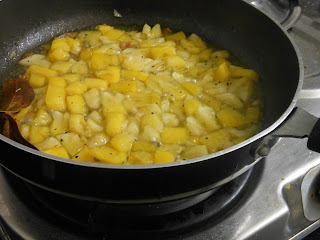


Today, I tried my hand for the first time at a small but an essential part of the traditional Bengali meal: the chutney ('chaatni'). I made a pineapple chutney borrowing the recipe online, ofcourse with my own twist on it!
Annarser (Pineapple) Chutney
Ingredients
1/4th large pineapple chopped
2 tsps oil
1 tsp mustard seeds
1/4th inch ginger chopped
2 bay leaves
1 cup water
4 tbsps sugar
Method
In a pan, heat the oil and add the mustard seeds to crackle. After the mustard seeds crackle add in the ginger and the bay leaves. Add in the chopped pineapple and sautee a bit.

Pineapples being sauteed in the tadka
Now add the water and the sugar and stir and cook till the chutney thickens.

Cool and serve. In a traditional Bengali meal, a course is papad served with chutney.

The chutney

The chutney up close
The next time I am going to try and chop the pineapples a bit finer and make the chutney a little more syrupy. Though it turned a little bit dryish than what I have seen, the taste was brilliant!
Subscribe to:
Posts (Atom)