Tuesday, 30 July 2013

Umami: The Elusive Fifth Taste

We have all learnt about the four basic tastes: sweet, salty, sour and bitter and we also know the different sensitivity of the different parts of the tongues to these tastes.

There are more than these four basic tastes however. The fifth taste that we hear less often of is umami that is the taste of amino acids such monosodium glutamate (ajinomoto), cheese or meats. When I heard about this new taste, I went back and thought about the taste of cheese. Yes, it has a salty edge, but if you think back on it, the particular taste of cheese does not really fit into any of the four basic taste categories.

As we all know tastes interact with each other. A little bit of saltiness brings out sweet taste. If you see we do not use unsalted butter for baking even though it is commonly available. I have seen many sweet baking recipes where Sanjeev Kapoor has added a little pinch of salt to the batter or dough. Sourness brings out saltiness. Have you ever drizzled a dash of vinegar on your chips? Now you know why they get tastier (apart from the fact that they are fried of course!)

The interesting effect of this taste is that it brings out the flavour of all the tastes. This is because it enhances the binding of the taste molecules to their particular receptors on their respective taste buds. Think about it, when we add cheese to a dish, it not only adds its own flavour to the dish, but the taste of other ingredients of the dish comes out better too. Now we know why the (Indian) Chinese food that we eat with MSG tastes good!

And apparently cheese is not only adds flavour to your pizzas and garlic bread and other savoury dishes but can also do it for your sweet dishes. One example of this that comes to my mind is the weird combination (to me) of cheese and jam sandwiches that a lot of people around me really relish and I have been asked to try. Maybe I will try them sometime and see!

So to knowing about the elusive and less heard of umami. 

Sunday, 28 July 2013

Homemade Wadas for a Rainy Day

They're spicy, they're crispy, they're tasty and they're everyone's go-to food in Mumbai... they're wadapavs! They're available at every corner (literally, just turn around and you'll see a gaadi or a small shop selling them). And the best part, they're extremely easy to make!

Wadas

Ingredients

6 medium sized potatoes boiled
3 green chillies
1/2 inch ginger
6-8 cloves of garlic
1/2 tsp asafoetida
1 1/2 tsps turmeric
2 tbsps oil
Salt to taste

For the batter

1 cup gram flour
5-6 tbsps water
Salt to taste

Oil for deep frying

Pav to serve

Method

Mash the boiled potatoes. Make a paste in the mixer of the ginger, garlic and chillies.

Heat the oil in a kadhai and add in the asafoetida. Now add the turmeric powder and the paste of the ginger, garlic and chillies. Fry for 30 seconds in the oil till the garlic loses its raw smell. Add in the mashed potatoes, the salt and mix well. Lower the flame and let the mixture cook for 10-12 minutes on a low flame. Keep stirring every 2-3 minutes to prevent the mixture from burning at the bottom.

Prepare the batter by mixing the gram flour, salt and the water. The batter should be really thick, like the consistency of dosa batter.

Heat the oil for frying. Make balls of the potato mixture of around 2 inch diameter and flatten a little on the palm. Coat with the batter and fry in the hot oil till both sides turn reddish.

Serve hot in fresh soft pavs with green chutney and date and jaggery chutney. Go to the balcony or window and enjoy with the rains!


Enjoy hot in the cool rains!


Friday, 26 July 2013

Joy

Hot wadapav from a gaadi in rainy weather... sometimes it's just as simple as that!

Thursday, 25 July 2013

On Eating Bitter Foods

As we all know, we have an innate dislike of bitter foods. This has evolved in us since in ancestral times where bitter tastes were an indicator of poisonous substances and avoiding them was key to our survival. So much so that we are sensitive to bitter taste in solutions that are 0.008 times as concentrated as salty or sweet solutions.

Despite this scientifically rational dislike there are people (and even communities) who claim to like bitter foods such as karela. In Bengali cuisine, for example, the first course or the appetizer course is predominated by bitter tasting dishes such as uchche charchari and shukto.

One of the reasons that struck me as underlying this preference is in the preparations that are eaten of these vegetables like bitter gourd. Bitter gourd, before being cooked is generally rubbed with salt and then squeezed to remove the bitterness (even by people who claim to like it!)I know of a lot of people who like karela chips that do taste bitter. It is just that they are fried and laden with calories, something the human body also has an evolved preference for. In uchche charchari, rice  and ghee are added to the bitter gourd which are carbohydrates and fats that our body needs whereas shukto has other vegetables and spices that we have learned to have a preference for.


So to get the nutrients we need, we have come up with ways of getting over the limitations of the substances we can get this from and making them more appealing to us. This in essence is where I guess cooking started from.

Saturday, 20 July 2013

The Dals Week 5: Palak Dal

Some more experimenting with dals! Dals are a rich source of protein and adding in spinach makes it almost complete meal in itself. Adding spinach also adds a great new flavour to the bland dal that complements it well. It is a great way  to hide greens so your kids will eat them!


Dal with a green twist!


Palak Dal

Ingredients

3/4 cup toor dal

2 tbsps oil
1 tsp mustard seeds
1 tsp cumin seeds
1 tsp asafoetida
6 cloves of garlic finely chopped
1 medium onion finely chopped
2 tsps turmeric powder
2 tsps chilly powder
1 tsp cumin powder
3 tsps garam masala powder
15-20 leaves of spinach shredded
2 pieces of dried kokum or juice of 1/2 lemon
Salt to taste

Method

Soak the toor dal in 2 cups of water for an hour. Add 1 more cup of water and pressure cook for 3 whistles on a high flame and cook on low flame for 8-10 minutes. Remove and blend to form a mixture with soup like consistency. Add a little more water if you want the dal to be thinner.

Heat oil in a pan and temper with mustard seeds, cumin seeds and asafoetida. Once the seeds splutter, lower to a medium high flame and add in the chopped garlic. Fry for 1-2 minutes till the garlic starts turning golden brown.

Add in the chopped onions and fry till they start losing their rawness and start releasing the oil. Now add the turmeric powder, the chilly powder, the cumin powder and the garam masala powder and roast till the masalas start releasing the oil.

Now add in the spinach and fry with the onions, garlic and masalas till it loses water and becomes about half in volume.

To this, add in the cooked toor dal, and salt. Bring to a boil. Add in the lemon juice/ kokum and let it simmer on a low flame for 8-10 minutes. And voila!


Serve hot with steaming rice!


Friday, 19 July 2013

The Dals Week 4: Upma

When I started the dals week, I was thinking about the versatility of dals. They not just as used to make dal for dipping rotis or having rice with, they are also used to add texture to pliant vegetables and flavor to bland ingredients like rawa in upma.

So coming to upma, I recently tried the recipe using udad dal in it about two months back and have transformed from a ­I-HATE-upma  to a I-LOVE-upma person! I have had more upma in these last two months than I have even bothered to look at in my entire life. I have found the balance of flavours in it that I enjoy, and I really am enjoying it!


Upmaaaaaaaaaaa!


Upma

Ingredients

2 tbsps oil
2 tsps mustard seeds
1 tsp asafoetida powder
10-15 curry leaves
2 tbsps white udad dal
1 medium onion finely chopped
1 cup rawa
3 cups water
3-4 tbsps lemon juice
Salt to taste
Finely chopped corriander to garnish

Method

Heat a pan and dry roast the rawa on a low flame for 7-8 minutes till it starts turning reddish and releases its aroma. Remove and keep aside.

On the other side, heat the water till it comes to a boiling point and let it be.
In the same pan, heat the oil. Add the mustard seeds and the asafoetida powder. When the mustard seeds start to splutter, add the curry leaves and let them crackle.

Now, lower the flame and add in the white udad dal. Fry in the oil on the low flame till its starts turning red.

Add in the finely chopped onion and fry till it softens and starts losing its raw aroma. Now add in the roasted rawa and sauté it for 2-3 minutes.

Pour the hot water into the rawa mixture and add the salt. Bring to a boil. Then on a medium high flame let the rawa mixture cook in the water till it starts to thicken and achieve a porridge-like consistency. You can let it continue cooking for a bit more if you like it thicker.

Lastly, add in the lemon juice.

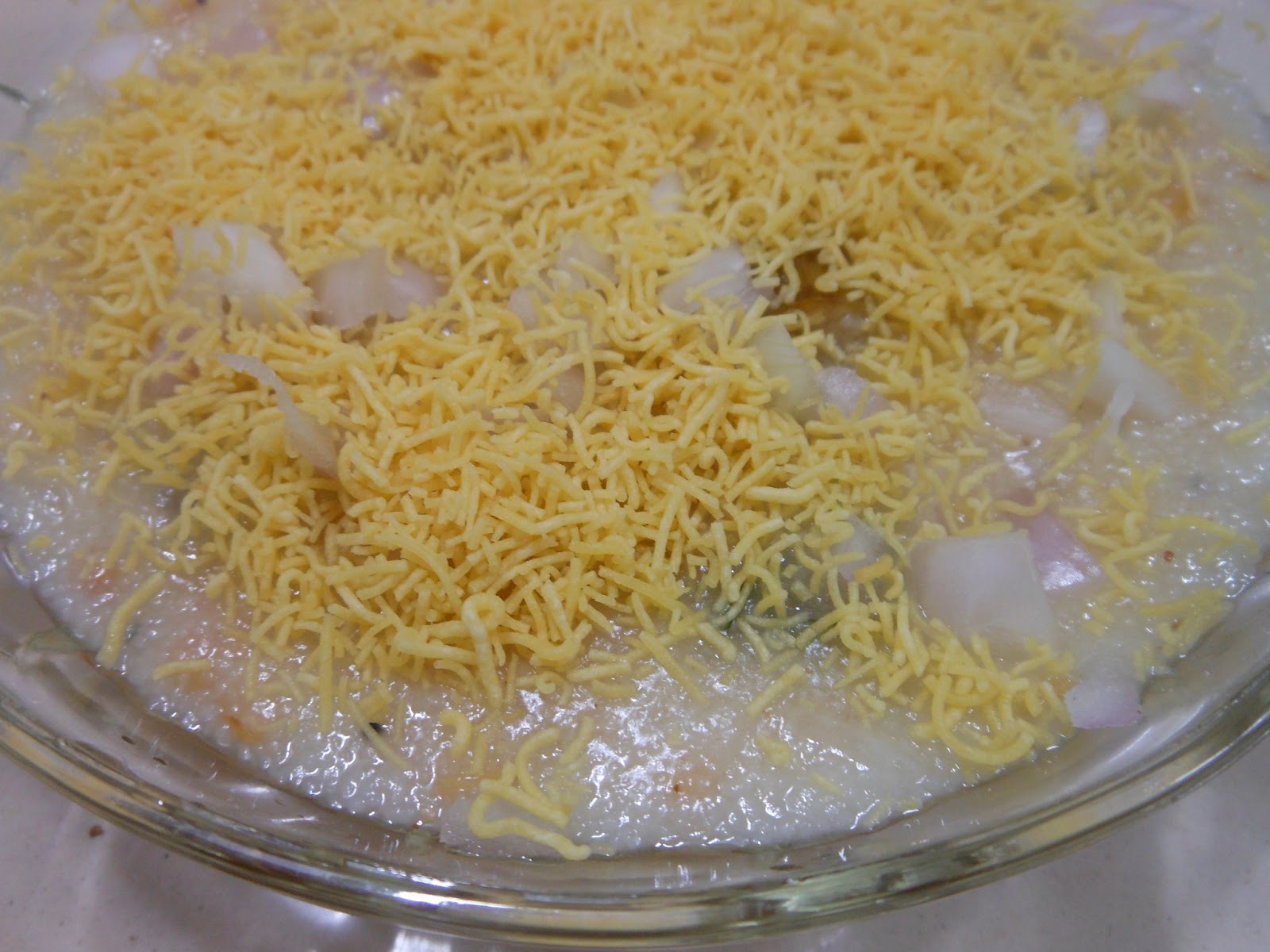
Serve hot topped with fresh corriander or sev and chopped onion. Don’t wait, dig in!


Upma with sev and chopped onion


P.S. You can add in more vegetables such as carrots, beans or peas. Just parboil them and add them in about 2 minutes before your desired consistency is achieved so as to avoid overcooking of the vegetables.

Thursday, 18 July 2013

The Dals Week 3: Maharashtrian Aamti

We all know that everyday lunches and dinners are generally full meals with at least one sabzi, dal, roti, and rice and then the add-ons. When having lunch or dinner at home, I eat either roti or rice, and preferably roti (I like rice a little less). Except when there is aamti. Then I will eat some rice, even if it's two morsels, despite how many rotis I have polished off! That's the magic of this everyday Maharashtrian dal for me! There are various recipes for aamti and you can add vegetables such as drumsticks to it, but  I generally make the basic aamti quite often.

This recipe uses goda masala for flavour. Goda masala is made primarily of corriander seeds with small amounts of 10-12 other spices (the recipe varies in each home) such as 2 types of cumin seeds, bay leaves, 2-3 types of red chilly, cloves, 2 types of cardamom, dried coconut etc. It is one of the three basic spice powders used in everyday Maharashtrian cooking, along with turmeric powder and dried red chilly powder. Like in Gujarati cuisine we have dhania-jeera powder with turmeric powder and dried red chilly powder and in Punjabi cuisine there is garam masala apart from turmeric and chilly powder. It is one of the three masala powders the regular seven spice box that we see in almost all Indian homes carries in Maharashtrian homes.

Goda masala can be brought in stores and there is no substitute really to it. Garam masala with the five or six basic spices used in it doesn't come close. If you get goda masala, open it and just take a whiff of the smell of the masala. The notes of pungent, piquant, with an edge of sweet at the end will be proof of what I am talking of! 


Aamti

Ingredients

1 cup toor dal

2 tbsps oil
1 tsp cumin seeds
1 tsp mustard seeds
1 tsp asafoetida
1 medium onion finely chopped
1 1/2 tsps turmeric powder 
1 1/2 tsps dried red chilly powder
2 tsps goda masala
3-4 dried kokum pieces or 1 1/2 tsp kokum extract
1 tsp jaggery
Salt to taste
Fresh chopped corriander to garnish

Soak the dal in 3 cups of water for at least half an hour. Add salt and turmeric and pressure cook for 3 whistles on high flame and about 5-7 minutes on low flame. Remove and blend to get a thick-soup like consistency.

In a deep pan, heat the oil. Add the cumin and the mustard seeds. When they start to splutter, add in the asafoetida powder and the chopped onion. Cook the onion for 3-4 minutes on the medium flame in the tadka. 

Once the onions are reddish, add in the chilly powder and the goda masala and roast for about 2 minutes till the masalas release the oil.

Now add in the cooked dal, the kokum (extract), the salt and the jaggery. Bring it to a boil on high flame and then let it simmer on low flame for 8-10 minutes.

Garnish with chopped corriander and serve hot with steamed rice and a dash of lemon juice!


All it needs is steamed rice and a dash of lemon juice!