Tuesday, 2 July 2013

Pasta in Pesto Cream Sauce

It was liked by a close one who doesn't generally like pasta and avoids eating it! Need I say more?

Ingredients

For the pesto sauce

25-30 leaves of Italian basil (not Thai basil or Indian basil, which is our very own tulsi)
3-4 cloves of garlic
2 tbsps olive oil
6-8 walnuts
Salt to taste

For the pasta in pesto cream sauce

1 cup of penne/ fusilli pasta cooked according to packet instructions
2 tbsps olive oil
2-3 tbsps of pesto sauce
30 ml cream
200 ml milk
20 gms grated cheese (optional)
Salt to taste

Method

Blend all the ingredients of the pesto sauce in the mixer till a thick paste of chutney-like consistency is formed.

Heat a pan, add the olive oil and 2 tbsps of the pesto sauce and let it saute lightly for 2-3 mins (Italian basil becomes sweeter on cooking so do not cook too much or it will lose the piquancy completely).
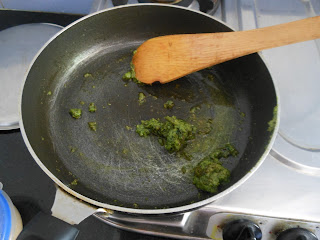

Pesto sauce being sauteed in olive oil


Add in the milk, the cream and the cheese and the salt and cook till the sauce thickens. Adjust seasoning and add more pesto sauce if you want more flavour.


Pesto sauce with cream, milk and cheese added in

To this add cooked pasta and stir till the pesto cream sauce coats the pasta and cook for a couple of minutes. Add more milk if you want it creamier (it's the healthier option than cream!)


Pasta added into the pesto cream sauce

Serve hot and dig in!


Pasta in a creamy pesto sauce served hot!


Sunday, 19 May 2013

Papad ki Dahiwaali Sabzi

Pick up the wrong packet, add significant amount of chaat masala instead of garam masala to a dahi-based sabzi  (that already is a little sour!), panic a bit, then thankfully remember you haven't stirred it in, use a large spoon to quickly spoon out the part of the gravy where the chaat masala has fallen, throw it (literally) from afar into the sink and add garam masala... and after it is all ok, just keep stirring nonchalantly as if nothing has happened! Cooking, does have it's moments and well this one will always be associated for me with making this sabzi (because it was the second time only I was trying it out!)


Papad ki Dahiwaali Sabzi


Papad ki Dahiwaali Sabzi

Ingredients

2 cups dahi
4 tbsps gram flour (besan)
11 /2 tsps red chilly powder
1/2 tsp turmeric powder
3 cups water
1 tbsp oil
1 tsp cumin seeds (jeera)
1/2 tsp hing
3-4 whole cloves
2 whole dried red chillies

1 tsp jeera powder
1 1/2 tsp garam masala powder
Salt to taste
2-3 large papads (preferably the udad or  mung ones)
Fresh corriander leaves chopped for garnishing

Method

Roast the papads either on a tawa or on the gas or in the microwave as you prefer and break into pieces of about 2 inches.


In a bowl, whisk together the dahi, the gram flour, the salt, the turmeric and the red chilly powder.


The dahi-gram flour mixture, the papads, and the ingredients for the tadka


Heat the oil in a deep frying pan and add the cumin seeds. When they start to crackle, add the hing, the cloves, the whole dried red chillies. Pour in the dahi-gram flour mixture and let it come to a boil. Once it comes to boil, it will start to thicken; lower the flame at this point.


Stage 2 with the dahi mixture poured in after the tadka


Add the papad pieces, the garam masala and roasted jeera powder and let it cook in for about 2-3 minutes on the low flame. Do not cook too much and too fast on a fast flame or the dahi will curdle.


Adding in the papads


Garnish with fresh corriander leaves and serve hot with rotis or rice!


The fresh hot sabzi

Friday, 3 May 2013

Aloo Parathas

Very few things can be compared to the joy of licking dripping golden butter off a hot paratha. My favourite kind of parathas are the very simple and very humble aloo parathas.

I have always wanted to have the typical maa ke haath ka parathas made by a Punjabi mom (if you've never had one of these, put it on your bucket list!). I finally got this opportunity very recently this Tuesday when one of my neighbours' mother came down for a visit from Delhi. My only food request to her was the regular everyday aloo paratha and not any of the other elaborate dishes she offered to lovingly cook for me.  

So I had these awesome parathas and I managed to get the recipe too.... it was a double whammy for me! Today I tried them out and they turned out to be almost as good as those I just had on Tuesday...

Aloo Parathas 

Ingredients

For the dough

3 cups of whole wheat flour
A pinch or two of salt
Water to knead the dough

For the filling

5-6 potatoes boiled and mashed
1 medium onion finely chopped
8-10 stalks of fresh corriander finely chopped 
Salt to taste
2-3 tsps chilly powder
2-3 tsps garam masala
1-2 tsps amchur powder

Oil to shallow fry the parathas

For the dough, add the salt to the wheat flour and knead it by slowly adding small quantities of water till it forms a firm yet slightly elastic dough. Let it rest for half hour.  

For the filling, mix together the potatoes, onion, corriander, and add the salt and the masalas and mix well. Taste a little bit of the filling to check for the flavour of the masalas in the filling. If you feel masalas are just right or less, add in some more as there will be a paratha covering too.


The aloo filling for the parathas


To make the parathas, first roll out the dough into half a roti, put in a small sized ball of the filling in the middle, cover it up with the edges of the roti and roll out to a paratha.

Shallow fry on a tawa with a little oil on both sides.


The aloo paratha fresh off the stove


Serve hot with chutney, ketchup, pickles, curd or simply a dollop of butter. I had mine today with aamras!


Aloo paratha- aamras my meal today!

Sunday, 21 April 2013

A Morsel of Childhood

A small hot ball of rice, mixed with a dab of ghee and a sprinkle of salt, fed to me by the loving fragrant and slightly wrinkled hands of my grandma... I want a morsel of 'that' simply flavoured rice, a morsel of the simplicity of childhood...

Thursday, 21 March 2013

Hummus

For me, memories get attached to a food experience. So apart from the taste, flavours, touch, smell and textures of the food I am eating, the memories I create become an integral part of the food experience. So when I want to revisit those memories, I try and cook that dish in the kitchen. Since yesterday I have wanted to revisit some beautiful memories I have created eating hummus with fried pita bread from a small shop in the food court of a local mall so here I have been able to cook it today (the chickpeas need overnight soaking!)

Hummus is a traditional Lebanese dip made of chickpeas with a drizzle of olive oil on top served with hot and fresh soft pita breads (though fried pita bread sticks make for an interesting texture combination). Though not bland, it doesn't have too many complicated flavours (and isn't a complicated recipe!) and goes well with chips, khakra, and other such kinds of bread! It is also a spread used in falafel sandwiches and rolls.


Hummus served with olive oil and a drizzle of paprika


Hummus

Ingredients

1 cup chickpeas soaked overnight
5 tbsps seasame seeds
8-10 garlic cloves
3 tbsps Olive oil
Salt to taste
Water to adjust consistency

Method

Soak the chickpeas overnight at least for 10 to 12 hours and cook in a pressure cooker till done.

To make the tahini paste (that can be used in baba ghanouj, another Lebanese dip), toast the sesame seeds lightly in a thick bottomed pan on slow heat till they are slightly brown and before they start popping out of the pan like popcorn. Blend this in a food processor or mixer with 1 tbsp of the olive oil or a bit more to ensure it isn't dry.

To make the hummus, blend in a mixer or food processor the chickpeas, garlic, tahini paste and salt  with about 2 tbsps of the olive oil and water as desired to get a thick dip like consistency.

Serve in a bowl with olive oil poured on top.

Serving tip: I serve with a pinch of red chilly powder and roasted jeera powder sprinkled on top as it goes wonderful with the flavours of the dip and suits the Indian pallet's penchant for spices.

Tip 2: I also add 1 tsp of curd to the hummus mixture to add a beautiful texture and a depth of flavour.


Hummus ready to be eaten!


Just another angle shot of the hummus


Monday, 11 March 2013

An Aha Moment about Beginnings of Salt Pepper and Spice

Last evening, a chat with a friend about food (yes, what else?!) brought on the realisation of learning to cook that I have always believed in but never phrased before.

So he was telling me about his attempt to cook by experimenting with thai green curry and tofu.

Ah! my aha moment! I have heard of quite a few people having this experience; they won't cook generally and when they feel like learning to cook they will start with something really fancy or foreign and since it won't turn out to be good most of the times, they will be turned off from the experience of cooking.

My experience of cooking and what I have heard of from people who love cooking around me has been of starting with traditional foods. My first experiences of cooking were when I was eight years old. My grandmother's legs weren't functioning too well, but she still would cook; so she would turn on the stove, put all the vegetables/ dal with the tadka, come and sit outside in her chair in the living room and then open the magic box, the masala box as I saw it. I would stare at her in awe as she measured out these small mounds of masalas with just her fingers (yes she never used any measures but was always so perfect in her measurement!) and then ask me to go add them to the dal and the vegetables and keep an eye. These magic powders started to hold me in amazement because of what they did to those bland vegetables and dals. I started being able to name all these powders, distinguish them by what they did to the foods and what flavours they brought. Once I started understanding this alchemical process, I could enjoy it more and as my basics strengthened, I started to have the confidence to try my own recipes.

Another important thing with traditional food is that you know so well what it is supposed to taste like at the end and there is someone with a lot of experience to guide you about how to get there, to get it to taste just right! This voice of experience and guidance is one of the most important things to cooking according to me. This someone can explain the new  and old spices to you, what do they do to the food and how to get them to create magic and not a mess! I may have sometimes taken for granted the ease and the confidence my grandmother was able to instill in me about cooking from a very young age, but I never can forget her contributions to my love for cooking. A good guide, be it your mother, grandmother, your friend or anyone (gender-neutral anyone) can make cooking a wondrous experience for you.

And once the comfort level with the basics is established, it becomes easier to move on to new creations with these familiar tastes and then adding a novel taste or going to more foreign dishes. This comfort could make cooking more than just a necessary chore! 

Sunday, 3 March 2013

First Time

In my 11 years of cooking, today was the first time ever I have ended up putting too much salt in a dish.  My regular strategy is too add less salt, because you can always add some more salt if needed while eating but too much salt is an incurable disaster.

Then again, my parents and brother did not find it too salty so maybe it was just me as I do eat less salt compared to them. To me it was too much and this was my first time making that mistake!